 Vietnam Seaports Association

In 2025, container throughput at ports worldwide continued to grow, while market share became more concentrated among large operators. At the same time, capacity investment, links between shipping lines and terminals, automation, and greener operations are becoming key industry trends.
Global terminal operators near 50% market share
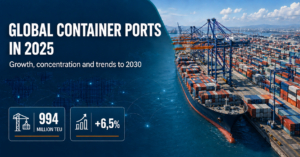
According to Drewry Shipping Consultants’ “Global Container Terminal Operators Annual Review and Forecast 2026/27”, global container port throughput reached 994 million TEU in 2025, up 6.5% from the previous year.
Meanwhile, throughput based on ownership share at the 19 global container terminal operators grew by an average of 8.9%, higher than the overall market. Their market share rose from 48.8% in 2024 to 49.9% in 2025.
PSA International remained at the top of the ranking, with throughput based on ownership share at 69.9 million TEU, up 5.3%. Eight of the 19 operators recorded double-digit growth.
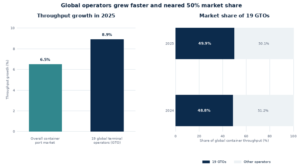
Chart 1. Throughput growth and market share of global container terminal operators
Operators linked to shipping lines continue to expand
Drewry noted the growth of AD Ports and Adani, as well as operators linked to shipping lines such as CMA CGM, MSC Group, APM Terminals, and Hanseatic Global Terminals.
Taking part in both sea transport and terminal operations gives these companies an advantage in securing cargo, expanding networks, and developing new port projects. In terms of operating reach, DP World and MSC Group invest in terminals in all 10 regions classified by Drewry. APM Terminals, Hutchison Ports, CMA CGM, and ICTSI are present in 9 regions; PSA International in 8; and China COSCO Shipping and Evergreen in 7.
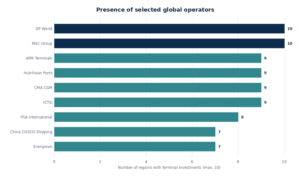
Chart 2. Presence of selected global container terminal operators
Capacity investment continues to increase through 2030
Capital investment by the companies surveyed by Drewry rose 23% in 2025, focused on expanding port portfolios, upgrading infrastructure, and automating and digitalizing operations.
From 2025 to 2030, the operators are expected to add about 186 million TEU of capacity to their portfolios. Drewry noted that this figure may include some double counting because many terminals are jointly owned.
New projects account for 23% of the added capacity. MSC Group and CMA CGM are each expected to add more than 8 million TEU of capacity from new projects by 2030. Adani and Hanseatic Global Terminals are expected to add at least 4 million TEU each.
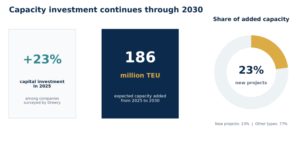
Chart 3. Key investment and capacity figures for 2025-2030
Concessions, mergers and acquisitions, and greener operations
The report shows that the port terminal industry is entering a new concession cycle. Many contracts signed during port privatization in the late 1990s and early 2000s are nearing the end of their initial terms. Operators must therefore prepare for renewals, changes to operating conditions, and adjustments to their asset portfolios.
Mergers and acquisitions continue, but they are increasingly affected by geopolitical conditions and investment control rules for strategic infrastructure.
Moving to greener operations has also become a common requirement. All 19 operators in the ranking have announced net-zero emission targets for 2040-2060. The main measures include improving operating efficiency, reducing energy use, and using more electricity from renewable sources.
Trends to watch
The 2025 picture shows that the container terminal market continues to grow but is becoming more concentrated among large companies. In the coming period, the expansion of operators linked to shipping lines, capacity investment to 2030, concession renewal cycles, and the move to greener operations will continue to shape the industry.
For Vietnamese ports, these trends can be used as references when planning investment, developing infrastructure connections, using technology, and improving competitiveness.
Sources: Drewry,…