 Vietnam Seaports Association

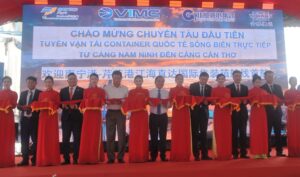
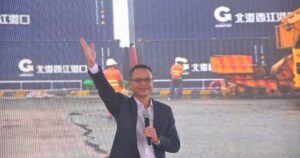
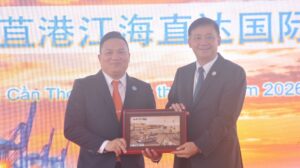
On September 24, 2026, at Cai Cui Port, Can Tho Port Joint Stock Company, Vietnam Maritime Corporation (VIMC) and Beibu Gulf Port Group (China) held a ceremony to welcome the first vessel operating on the international river-sea container route connecting Nanning Port, Guangxi (China) with Can Tho Port via the Pinglu Canal. The new route establishes an additional direct logistics corridor connecting Southwestern China with the Mekong Delta.
The Nanning – Can Tho service is expected to operate twice a month, with a transit time of approximately seven days. The route uses river-sea container vessels with a deadweight of around 4,900 DWT and a maximum capacity of approximately 500 TEUs.
The first vessel, BBG Nan Ning Bo Run, sails under the Panama flag. Built in 2021, the vessel is 100 meters long and 22 meters wide, with a deadweight of 4,900 DWT. Under the planned operation, approximately 25% of the vessel’s capacity is allocated to refrigerated containers and 75% to dry containers.
Expanding logistics connectivity between Southwestern China and the Mekong Delta
The Nanning – Can Tho route is jointly developed by VIMC, Can Tho Port and Beibu Gulf Port Group, with the participation of transport, logistics and cargo-owning enterprises.
Speaking at the ceremony, Mr. Le Cong Ly, Standing Vice Chairman of the People’s Committee of Can Tho City, said that the arrival of the first vessel from Nanning via the Pinglu Canal to Can Tho Port not only marks the establishment of a new international shipping route but also provides an additional cargo connection between Southwestern China, Can Tho and the Mekong Delta.
According to Mr. Le Cong Ly, Can Tho Port’s container handling capacity has continued to grow. In the first six months of 2026, container throughput reached 12,665 TEUs, representing a 162.49% increase year-on-year. The port has also developed container services connecting Can Tho with Ho Chi Minh City and the Cai Mep – Vung Tau area.
The new route is expected to create additional trading opportunities, improve supply chain efficiency and strengthen Can Tho’s role as a logistics hub for the Mekong Delta, a region with strong agricultural, seafood and food-processing industries.
Strengthening connectivity and developing two-way cargo flows
According to Mr. Le Quang Trung, Deputy General Director of VIMC, Can Tho Port plays an important role in bringing VIMC’s resources closer to the cargo base of the Mekong Delta.
To ensure stable operations, VIMC is focusing on three areas: network connectivity, two-way cargo development, and service and data integration.
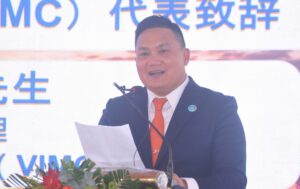
A balanced cargo flow in both directions is considered essential for maintaining stable schedules, improving service competitiveness and enabling businesses to develop long-term plans.
VIMC will also continue promoting digitalization, data sharing and coordination among its units to reduce waiting times, improve transparency and enhance service efficiency.
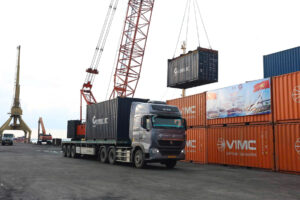
Prior to the official launch, on August 4, 2026, the vessel M/V Li Da Tong 2 Hao from Qinzhou Port called at Cai Cui Port as part of a trial international container service connecting Can Tho with Guangxi. The trial voyage carried 66 containers of agricultural products from the Mekong Delta to Guangxi, allowing the parties to assess cargo handling, service coordination and market demand.
Leveraging the potential of the Pinglu Canal
From the Chinese side, Mr. Hu Huaping, Secretary of the Party Committee and Chairman of Beibu Gulf Port Group, said the launch of the Nanning – Can Tho route represents a new step in connectivity cooperation between Beibu Gulf Port and Cai Cui Port, while leveraging opportunities created by the Pinglu Canal to develop a new international trade corridor.
Beibu Gulf Port serves as a maritime gateway from Southwestern China to ASEAN, while Can Tho Port plays an important role in the Mekong Delta and provides connections to Southern Vietnam and the Mekong River basin.
The new route provides additional transport options for agricultural products, seafood and processed goods from the Mekong Delta to Guangxi and further into Southwestern China. In the opposite direction, products from China, including automotive and motorcycle parts and chemical products, will have an additional direct transport option to Southern Vietnam.
According to information presented at the ceremony, bilateral import and export turnover between Guangxi and Vietnam exceeded RMB 300 billion, equivalent to approximately USD 44.7 billion, for the first time in 2025. Vietnam has also remained Guangxi’s largest trading partner for 27 consecutive years.
The launch of the Nanning – Can Tho international river-sea container service provides an additional direct logistics option for businesses and expands Can Tho Port’s container network from domestic and domestic transshipment services to international connectivity.
The new route is expected to gradually establish a logistics corridor linking the Pinglu Canal, Guangxi and the Mekong Delta, supporting two-way cargo flows and strengthening trade connectivity between Vietnam and China.